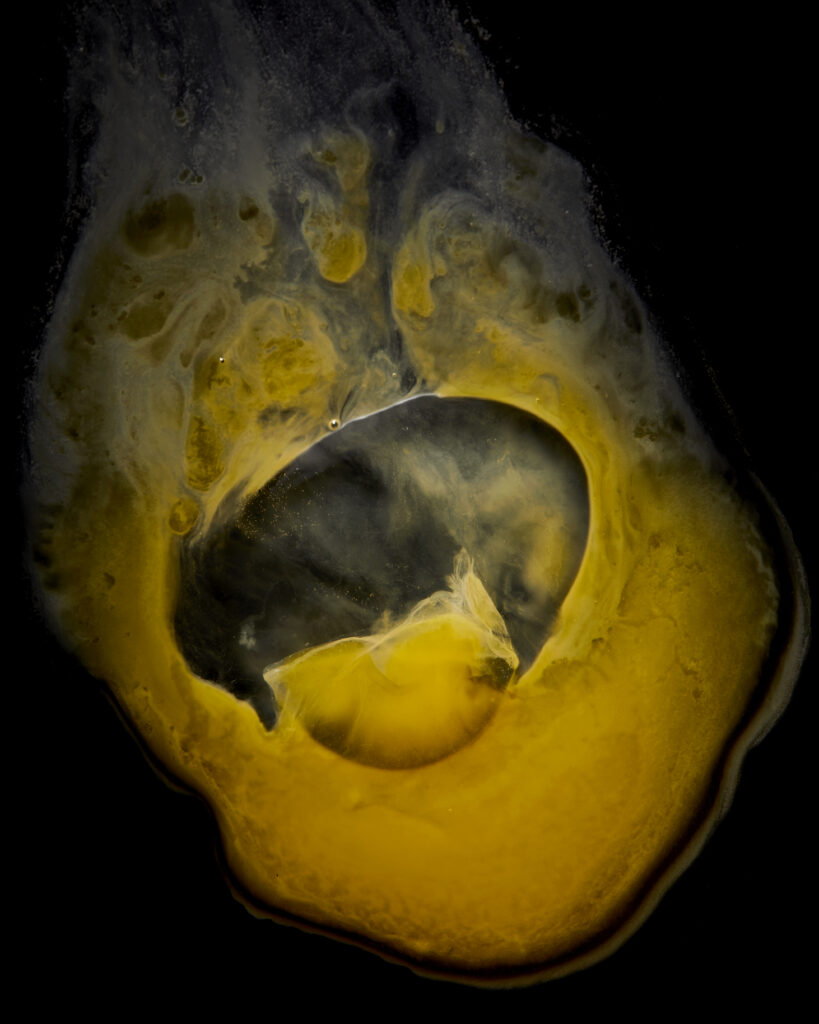
Today we saw his heart beating for the first time, and our hearts responded with a giddy flush. This sea of black, housing a cocoon, housing a smaller sea, encircling a butterfly.
When I went home, I started straightening up my existing daughter’s room. We’ve recently rearranged her furniture, and some objects haven’t found their new nooks. I reached in the corner and picked up a small crystal ball, attached to a clear plastic string. This used to hang in a window behind her bed, but the crystal must’ve jostled loose, now hidden behind blankets and stuffed friends.
I walked around the house searching for an optimal place for rainbow-making. My dad got me obsessed with light prisms as a baby, and I’d already adorned several sills in my home. My dad had cut-glass crystal balls and striated quartz crystals in his bedroom window, which caught the sun every morning and afternoon, throwing refractions all over the walls in the full spectrum. It was pastel, science fiction, and a holdover from Dad’s 1970s esthetic, but really, it was magic to me.
I walked into the kitchen and considered the light. I decided to hang it in the box bay window over the sink. I climbed the step ladder and held the crystal in my hand. It had a pink tint, and hardly any weight, but it seemed to inflect a glimmer all on its own. After I hung it, I watched it swing—a quick little motion, like the embryo’s heart on the ultrasound. I watched it swing, and swing, and swing, back and forth. Precious little thing. I knew that from now on, this crystal would remind me of that tiny heart.
We’ve been here before. We’ve been to this moment of potential, when the whoosh of life blooms, like a metronome, through the machine. We know where this path could lead.
The first time I was ever pregnant, open awkwardly to the doctor’s probe, my daughter’s heartbeat gushed through the ultrasound speakers, and I laughed. I was already more than two months in, but I hadn’t even known I was pregnant until the week before. No sickness yet; so far this had just been a hoot. I listened to the ultrasound machine, like music, to this steady thrum of life from inside me.
For the first trimester, it was all a fascinating, exciting, and eventually nauseating chemistry experiment. Essentially, every OBGYN appointment I had went something like this: Baby girl meeting her markers, getting more and more audacious with her four-on-the-floor chest beat. Towards the end of my pregnancy, I had complications due to Crohn’s Disease. This is a whole separate story unto itself, but essentially, the full armada of my body’s defense system flipped on me—this is what autoimmune diseases do. The scaffolding of my physical being—my joints, my organs, everything except my womb—began to rapidly fall apart. However, where my body failed most of me, somehow my body protected my baby. Despite the trauma I endured, I had no idea how lucky I was.
When my girl was two years old, I lost someone. We weren’t trying, but there was a month with too much blood, and I knew what had happened. It hit me that this little one, this one I hadn’t known was with me, had gone right through me. I’d never gotten to know them. Never sang them a song. I didn’t expect the sense of emptiness which followed the absence of someone I hadn’t known was there. That was my first miscarriage.
There is a sense, during pregnancy, that you are sharing energy—not just nutrients and blood— but your emotions and intentions. This is not science. Or maybe it’s closer to theoretical physics, a very close quantum entanglement. Baby and mother are two particles, interacting in such a way that the state of one cannot be described independently of the other. I mean, they can—we are two separate beings—but the feeling is a borderless connection. A connection independent of time.
We intentionally tried again a couple of years later. We found out we were pregnant at six weeks, but at seven weeks, there was no heartbeat. No heart at all. It was a chromosomal problem, one of those wildcard obstacles that the pregnant body can identify, and once identified, discards. The female body is wise, but knowing that does not neutralize the pain of loss. It was only seven weeks, but my husband had bought me flowers and made a card with a hand-scrawled picture of a baby on it. We were not wise yet. We had only taken this path in one direction, until now.
So, in a few months, we tried again. I’d gotten back into my regular cycle; I was healthy and strong. Like the time before, we got the positive test, and I went in at six weeks. No heartbeat yet, but there was a speck in the dark. I went home hopeful, but cautiously so. I started to feel the nausea, and the fatigue, and all of the awful, necessary signs of metamorphosis. A few weeks later, I returned for the heartbeat ultrasound. There it was. Not just present, but strong.
“You’re having a Corona-baby,” joked my OBGYN. A bit of levity, five months into the COVID-19 pandemic.
My husband couldn’t be there because the clinic was not allowing partners as a precaution against crowding and viral transmission. I recorded the heartbeat into the voice memo app on my phone and sent it to my husband. We’d passed this threshold.
This time we told our daughter, and our parents and siblings. My girl touched my tummy, understanding that somebody was home in there. She was excited and fascinated. The nausea increased, and homeschooling (due to Covid lockdown) became even more exhausting than it was anyway. I talked with my girl about being a big sister, and I often talked to the little light in my universe about being a person. I sat in the yard and parted my shirt to let the sun touch my skin, and brighten their world.
Some weeks later, my nausea decreased. We were nearing the three-month mark, the second trimester, so I thought maybe this was ok. It was still lockdown, so I went to the clinic alone, and sat on the same couch as last time. Maybe a bit of superstition. They called me in, and I climbed into the exam chair, and I waited for the doctor. I sent thoughts into the abyss.
The nurse and the doctor came in together and began the ultrasound.
Silence.
The nurse turned the screen towards my OB.
“Doctor?”
I saw his face, no movement.
The doctor took a moment before he said anything, but I knew.
There was no heartbeat anymore. I had a crazy thought like what if somebody else’s ultrasound was recorded on the screen, and they forgot to change it—maybe the sound wasn’t working—no. My little one was gone, three months in.
They scheduled the D&C for that afternoon. They do it soon to reboot the cycle, restart the universe. One of the cruelties about this particular time was that because of the pandemic lockdown, I had to go through this alone. Not only did I feel the emotional absence of my baby, but the physical absence of loving support around me. Of course, at home, my husband and the rest of my family were there for me, but that afternoon in the sterile doctor’s office, there was only absence.
I allowed myself to cry in front of my daughter. I wanted her to understand that life is full of hard things, but we go through them together. It would’ve felt unnatural to have been pregnant and happy, and then to be un-pregnant, and neutral about it—to pretend that life was just going on as usual. In many modern cultures, there can be a sense of shame associated with loss, or pain—as if total success is the only acceptable life path—this perspective is profoundly broken and causes so many life experiences to go unseen and unheard. The loss of a pregnancy is not an embarrassment, it’s a difficult fact of life. With love, and the presence of our friends and families, we can move through it.
I’ve often thought, if I could speak to that baby who ceased to be, I would say: The time we had together was complete.
That was our moment, and it was unlike any other. Not because it was so many days, or so many months, but because it was ours. Our relationship was full of hope, and intimacy, and unconditional love. We had afternoons with mockingbirds in the margins of our consciousness, and little songs about nothing. We shared my blood and my oxygen, and I’m glad to have given it to you. Your impact on my life is unreplaceable, and thin as a veil, and far too short, and endless.
And now I stand in my kitchen watching this hanging crystal, winking with the coming afternoon. A new one has appeared in me. I don’t know how long our path will be, all I know is now. This moment when he is in the world as a flickering speck in the dark. This moment is alive, and it is all of now, and we exist together in this now, and the next moment will be its own story.
Raya Yarbrough is a writer and singer-songwriter best known for singing the opening title song of the TV series Outlander. Her creative nonfiction has been published in Frazzled, MUTHA Magazine, The City Key, and The Manifest Station. Her fiction has been published in Amazing Stories and Witchcraft, and her poetry has been featured in Writers Resist, One Page Poetry, and Poetry of the Sacred. Raya is currently finishing a humorous memoir about being a parent in a multiracial family while also being a working artist. rayayarbrough.com/
Photo by Kelsey Fugere