
We settled on the gay neighborhood, my wife Jessie and I, because it was familiar. My older brother had lived in Berlin in the 1980s, on Goltzstraße, down the block from Café M, one of Bowie’s haunts during his epoch-making years there. I remember my first pilgrimage to the bar, marveling at the way grizzled, veteran drunks perched themselves at the same wobbly, tin tables as second-hand-styled teens—leathery, habit-driven creatures of the savannah quenching their thirst alongside chic, migratory water birds. Thirty years later, Schöneberg was still hip and nonplussed, immune to the gleaming, late-capitalist blandness that was infiltrating other parts of the city, altering its identity, in my view for the worse. Much as I craved experience, I preferred things to remain as they were.
I’d visited Berlin several times over the decades, come to know my brother’s friends, many of whom still lived in the neighborhood. Architects and artists, doctors and teachers, connected to clinics and schools. Having this support network would be an advantage for our family of five. A leg up. Most of us did not even adequately speak the language. On the morning we arrived, one friend, a curator of city art tours, collected us at the airport and brought us directly to breakfast at the apartment of others, a lesbian couple who poured us celebratory mimosas and pulled out a single-person trampoline for the kids to jump on. I took a turn myself, daring, in those fragile first hours, to believe that I could shove a whole family’s lurking homesickness back up into the pale morning sky from which we’d descended. As for the temptation of all those gay bars on the ground, I’d not given it a thought.
It was a sabbatical year, the rarest of privileges, not to be squandered. When I pitched the idea of a year abroad, the whole family was game. The kids would attend school—second, sixth, and tenth grade—and Jessie was able to work remotely. As for me, I would write, learn a new Beethoven sonata on the piano, and, above all, binge on opera. The year 2013 marked the bicentenary of two titans, Giuseppe Verdi and Richard Wagner, composers whose works I had revered since my first encounters with classical music. The opera world would be celebrating in force. With three full-time, state-subsidized opera houses, Berlin kept the offerings plentiful for everyone—aristocratic, blue-haired couples and music-school nerds, hipsters venturing off beaten paths, international visitors, families, and, of course, all categories of queers. In that single season, slaking my own urgent thirst, I racked up thirty-seven performances.
When I wasn’t at the opera, I was holed up with Jessie in our apartment on Lindauerstraße, a quiet cul-de-sac where the canopies of mature trees provided dense shade. Aplace to see but not be seen. Around the corner, out in the open on busier, grimier Hohenstaufenstraße, was Club Milano, an erotic massage parlor. Next door to that was CDL Bar-Lounge-Club, whose posters announced, in English, upcoming theme nights: “Underwear Only,” “Naked with Mask.” Jessie and I passed these establishments, holding our second-grader’s hand, several times a day. They were across the street from the local elementary school that Lia, our youngest and the most competent in German, would attend. Next door to CDL was a dressmaker’s shop. No one seemed bothered by this incongruity, the well dressed and the undressed.
The neighborhood easily became home. Returning one night in late April from a performance of Verdi’s Don Carlo at the Deutsche Oper Berlin, I felt comfortable on the dark streets between the Nollendorfplatz U-Bahn station and our apartment on Lindauerstraße. After eight months in the city, the twelve-minute walk was second nature. I knew all of the gay bars from the outside—Romeo und Romeo, the Jaxx, Bull Berlin—but I’d never gone into any of them. More familiar to me were the Bio store, where I shopped for the family’s organic groceries, and the Bavarian bakery, whose tangy, crusty olive bread we all lusted after. Cooking has long been my safest and most natural way of expressing love, the kitchen my most devout space.
Before the opera, I’d eaten an early dinner alone at an Indian restaurant that I’d begun frequenting not only for its fiery vindaloo but also for its crew of dashing, doting waiters, standing erect in their tuxedos but still looking casual, as if their taut bodies were prepared to burst at any moment into a Bollywood number, calling me sir but looking me in the eyes as if we knew each other. But Don Carlo is a behemoth, Verdi’s longest score, and with midnight approaching, I was hungry again. I knew there was a burger joint that stayed open late down the block from the notorious Tom’s Bar on the corner, where, I’d learned already from my time here in the 80s, men reportedly had anonymous sex until dawn in semen-scented, subterranean cubicles. I eyed the bar’s entrance with suspicion and no small touch of prudish disgust. Ogling handsome servers was one thing, but the hard reality of gay sex was as fantastical to me at this point in my life, almost twenty years married to a woman, as a palm tree in Berlin. The sex worker spotted me a few doors down from the burger place. Calling out to me softly, he followed my steps with measured intention, superimposing new rhythms onto mine. Ignoring his gangster’s rasp—“Pssst! . . . Hey! . . . Sir!”—I tore through the restaurant’s door, where I hoped he would not follow. Perhaps, I thought, he could not. I was a stranger to the rules and customs of legalized prostitution. The host seated me at a high-top table facing the glass storefront. The man sat outside, a darkly handsome figure on the iron railing that ran along the street, a safety measure, I presumed, from a bygone era, nowadays a convenient place for Berliners to chain their bicycles. Squeezed between two bikes, legs dangling, hands on his knees, he looked through the window at me as I ate. And while at first I vigorously ignored him, eventually, like a storefront mannequin brought reluctantly to life, I started to look back.
My marriage was in trouble. I’d reached, in my manhood, a mid-life trench, and I’d pulled Jessie down into it with me. Some causes were obvious, a glare on the surface above. The shift in my work from teaching, which defined me, to administration, which repulsed me, was one. Heavier was the weight of my mother’s death the year before, which had broken me, sent me tumbling into an abyss of grief-induced rage. I’m a warm person, but I’ve always had my gnarly side. My mother boosted me, smoothed out my edges, kept me believing in the goodness inside me, the part of me that got me playing piano for the patients in the nursing home where she worked, the part that defended her against my often angry and volatile father. Without her reinforcing gaze, I was shriveling up, a once-vibrant artwork fading in plain daylight.
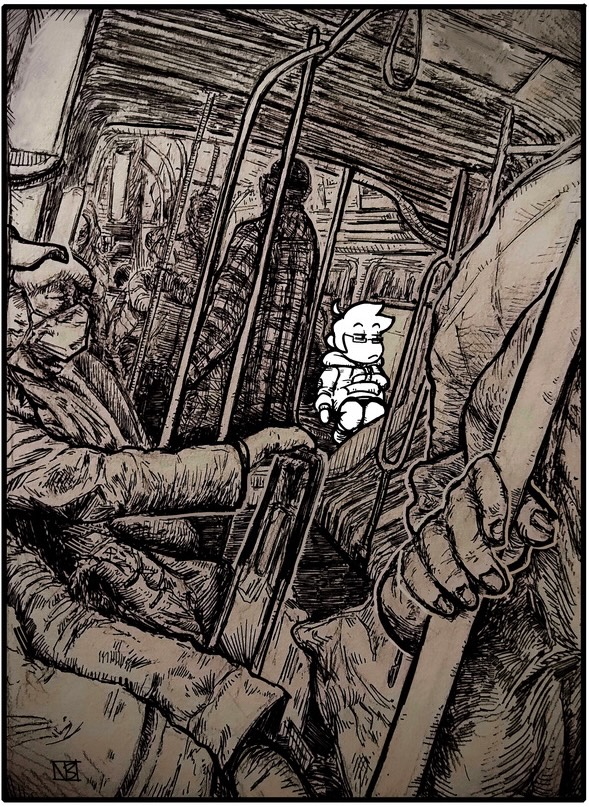
Sometimes it seemed my mother had been the only thing standing between me and a world towards which I was growing increasingly intolerant. Now, Jessie occupied that unenviable position, and instead of leaning on her, I rejected her, treated her as a cause for my unhappiness rather than part of a solution. My recalcitrant spirit thundered, my capacity for love diminished, even as my recipes improved. I ignored the love and companionship Jessie offered me and floated off into an ocean of cold silence, coursing towards anger like a shark to blood. I started to believe that only opera’s warmth could penetrate those depths. It started to be true. I paid attention mostly, that year, to the men’s voices. Dark and impenetrable, frustrated in lust, boiling with rage.
It wasn’t only work, of course, and it wasn’t only my mother. It was the pressure of what I was hiding, the animus behind my gaze at this man on the railing. I knew, sinking hungry teeth into my burger, that tonight I would only look, find other outlets for my desire. But the looking would fester. This charged moment would attach itself to other fibers, currents coursing through me, their pressure reshaping me, turning me into someone I no longer recognized. I’d take it out on Jessie, as my misogynist upbringing had taught me, and she, then, would be the one to burst. Instincts of an operatic villain, a lust-filled baritone, unsatiated, offloading his fury.
By now, after eight months in Schöneberg, a need was now crawling over me. My skin prickled with the heated sensation. And in the absence of a word or a touch from me, Jessie felt the same itch. At her own makeshift desk—the family dining table that sat along a row of floor to-ceiling windows in the living room, overlooking Lindauerstraße’s shielding trees—she conferred online with friends from her rowing club back home. One man in particular, himself unhappily married, offered frequent, perhaps inappropriate words of support. But who’s to say what’s appropriate when your husband won’t even talk to you? When he stays out after midnight on a gay stretch of Berlin? When he doesn’t have the balls to tell you that he resents you for not being a man?
As a drowsy server mopped the floor around me, I knew I would have to confront the man outside. The prostitute, the gigolo, the hustler. Here, in progressive Berlin, just a guy doing his job. His eyes for the past half-hour had barely left me. I’d taken him in, too. Turkish, I guessed, from his thick, black beard and olive coloring, also from the little I had heard about male sex workers in the city, where they came to Berlin from. Bright, piercing eyes, dark hair on the back of square hands, a compact, muscular frame, tight jeans advertising his wares. As I came outside, he hopped up pertly onto white sneakers and approached the door. “Hello,” I said without thinking, defaulting still, after all these months, to casual American friendliness. Seeing right through my straight-man disguise, formless khakis and a striped button-down, he knew he had a prospect.
As he walked alongside me, I decided I would humor him. When, at home, could I flirt with a man? I had only half a block before I would turn from this commercial street onto a residential one, only a few short blocks to my apartment. He would follow me no further than Tom’s Bar.
“Where are you from?” he asked, in English.
“The U.S.,” I offered shortly, and kept walking.
“Won’t you talk to me?” he persisted.
“I’m shy,” I said, quickening my pace, my academic brown loafers now adopting a nervous skitter, like a dog that’s just snatched a hunk of bread off the countertop. Suddenly, I wasn’t sure I wanted to be doing even this.
“What does that mean, ‘shy’?” he asked.
“Timid,” I responded.
“Timid is cute,” he said, “and you’re sexy,” jumping right to it.
We’d reached my turn. Tom’s loomed. “Oh, yeah?” I said, my teasing voice surprising me, tasting better on my tongue than it should. I stopped and turned to look him in the eyes. “Yeah,” he said. “You looking for fun? For sex?”
“No,” I said, mustering what conviction I could, the salty tang lingering. “Then why are you talking to me?” he challenged me, and I had to wonder. “I guess I’m curious. And you’re sexy, too.” My words were tentative, but truthful. I wanted to know something new, to expand. Maybe, just maybe, I wanted to have a sexual encounter with a stranger, a man, after all these years. Have my bread, with butter. Salted. Wanting it would not, I knew, lead me actually to do it. While I did not consider consensual sex work in general to be a moral problem, and while I supported Berlin’s attitudes towards it, I was in no position to take an active role in the enterprise. I was married and, if not much else, I was loyal. But acknowledging this hungry part of myself even to this stranger, to the empty night air, would turn my longing into something real. I would leave a phantom footprint of my desire on the sidewalk outside of Tom’s.
“Do you have money?” he asked.
“No!” With this, my voice rose in certainty. I would not pay for sex, not with the family finances that I kept under close scrutiny and doled out reluctantly, like a miserly king, to everyone in the house, including Jessie. We had no German bank account, only a credit card for emergencies. I withdrew cash once a week from our U.S. account, on Mondays, and kept the bills in a drawer. Our Berlin sojourn was not a money-making venture. Things were tight, but I was on top of it. “I wouldn’t be able to go through with it anyway,” I said. “I told you, I’m shy.”
“It’s ok. I like shy. Walk with me,” he said, now reaching out for my arm, softening the hard edge of seduction.
“No, I’m going this way,” I said, pointing towards my block, my starched arm angled away from his reach.
“Just come this way with me for a little,” he insisted, gesturing now in the other direction. On that stretch were several run-down hotels, a well-lit cash machine placed conveniently between two of them. “I like talking to you.”
And just like that, I turned. Away from home, from Jessie, the kids, from what I knew was the right thing to do. I wasn’t following him to have sex with him, only to prolong the foreplay. But even that was a betrayal. His hand swooshed against mine, and when that coarse hair brushed against my skin, I felt heat rise up from deep inside me, tingling my skin. Magnetized, like some sci-fi starship locked in a tractor beam, I fell into traitorous step. My night at the opera would include another act.
Earlier that evening, at Don Carlo, I’d heard the celebrated German singer René Pape as King Philip II of Spain, one of Verdi’s most imposing roles for bass. In an extended solo scene, Philip laments his wife’s lack of love for him. He shouldn’t be surprised: he had offered his son’s hand in marriage to her, the French princess, and the two young people, the tenor and soprano, had fallen in love. But at the last minute, the Kings of Spain and France had arranged for the princess instead to become a Queen, and so the prince’s fiancée became his stepmother, a shell standing by her husband’s side.
Verdi’s intention in this scene is to humanize Philip, extract our sympathy through the corporeal contours of melody, the living pulses of rhythm. But when the King, beginning in a brooding monotone then rising to impassioned, long-held notes at the top of his range, sings “She never loved me!” it’s difficult to feel sorry for him. We’ve never once seen him showing her love. We know their marriage is something he forced her into. Several fraught parallels nagged at the edges of my senses. Better, I thought, to ignore the unconvincing sentiment of the text and just listen to the singing. It’s why I went to the opera, to be washed clean by its rain of vocal timbres, touched by the singers’ invisible fingerprints.
A year after Berlin, at home in the States, Jessie told me she could no longer be witness to my freefall into negative space. She would finally free herself from my stranglehold. Later yet, some months into an on-again, off-again separation, like our engagement, she confessed to being in love with the man from the rowing club. “You didn’t give me time to fall in love with you,” she said at one point, referring to my pressuring her early in our relationship to get married. At this, Philip’s song came back to me with force. Perhaps she never loved me at all. And I wondered to what extent anyone should feel sorry for me if that were the case. Like Elisabeth, Philip’s detached Queen and Carlo’s lost love, I was the one whose heart had become inaccessible.
I was the one whose heart had led him here, to a dark urban street, walking with a man I both desired and feared, taking every opportunity to allow my body to bump against his, leading him nowhere, with no intention to let him earn his living. I rushed past the hotel entrances, making sure the man knew that a visit there was out of the question. At the end of the block, outside the incongruous American Diner, its gaudy neon signs illuminating the U-Bahn station where I had exited an hour before, the road curved into an undeveloped open area, a short stretch of urban wasteland. Suddenly, another man came swiftly around the other corner, as if from a menacing cloud of theatre smoke. I sensed that they knew each other. The newcomer, taller than his friend, raced towards me, waving his hands. “Hi!” he said in a voice louder than appropriate.
And then he was on me. Punched me in the gut, kicked me on the side of my knee, grabbed me from behind, pinning my arms as I doubled over. The first man jammed his hands in my pockets, not to fondle me, but to grab my wallet, which he fished out, opened, and emptied. I was carrying thirty Euros. He took the cash but left my credit cards, driver’s license, a decade’s worth of school photos of my children, all splayed out on the sidewalk, marking the disaster of this neon-soaked moment. An ugly American home to roost.
“You think you’re so smart,” he whispered, his burlap tenor now hard and cruel. I readied myself for an escalation of pain. “You think you can just talk to me and everything’s going to be fine.” He threw my empty wallet on the sidewalk next to its spilled contents and gave me another violent shove. I staggered, and my hands caught my fall on the gritty sidewalk, where I saw an image of my own face staring up at me. Gazing at my daughter’s portraits, I was overcome with humiliation. Their smiles, elicited by a friendly school photographer, were now frowns directed at their disgraced father. In silence, the two men dissolved back into the shadows. I picked up my pieces, stood up straight, assessed the scrapes on my hands. Then, shaken and ashamed, I headed home to the early spring leaves of Lindauerstraße.
The opera Don Carlo is based on a German stage play written in the 1780s by Friedrich von Schiller. It’s a historical drama of the Spanish Inquisition, a tale of sexual appetites and machinations at Court. But it’s also a family drama, of betrayals and bloodlines. Adapting it, Verdi and his collaborators added a character to Schiller’s already large cast. Unlike the others, who are all based on real historical figures, Rodrigo, the baritone, is a fiction. A tourist. A man, like me, on that deserted Berlin street, who doesn’t belong.
He’s also an unlikely baritone good-guy. A political revolutionary, Rodrigo serves the King but also, implausibly, advocates for the liberation of Flanders, which Spain controls. Confidante also to the unhinged Carlo, who is at constant war with his father, brave and bighearted Rodrigo compromises himself as he negotiates these competing loyalties. Eventually, incurring the King’s wrath, he sacrifices his life for Carlo, takes a bullet for his friend, sings a show-stopping death scene. Standing in the middle, wanting it all, king and prince, spouse and hustler, always comes at a cost.
The scene of Rodrigo’s murder is the opera’s emotional climax, a thrilling and tender double aria. After it, the soprano-Queen has her big solo number, and she and Carlo sing one last duet. But the death of the baritone has left them in a trance. Bereft of his devotion, their light dims. The opera’s confounding, murky conclusion is Verdi’s strangest. The sound of a friendless world. A musical wasteland, like that gloomy spot where I had been mugged. The last sound I had heard in the opera house, now lingering in my mind’s ear as I stumbled home. For I knew I could never tell anyone, even a best friend, about what had just happened. How I had paid for sex without even having it. How my privilege had caught up with me. How, in imagining what it might be like to add a man to my cast of women, I had come dangerously close to losing it all.
While the drama of Don Carlo does not require Rodrigo, opera’s musical logic insisted on the baritone’s expansion of tints. The baritone color was an essential feature of Verdi’s scores, even if it meant making an already complicated story more so. A historical fabrication, Rodrigo is on stage primarily to contribute his sound. Don Carlo features primo roles for soprano (the Queen), mezzo-soprano (her top noble attendant), tenor (the prince), and two basses (the King and the Grand Inquisitor). The baritone color illuminates the spaces that link them. This is why Rodrigo is a go-between, delivering secret notes, intercepting incendiary papers, making bargains, crusading for justice. Best friend to an angsty young royal, Rodrigo, the superfluous baritone, is music itself.
Fitting my key into the lock of our dignified, prewar apartment building, I thought about opera’s men, about Rodrigo and the music of male friendship. About my stunted desire. I had built myself a feminine fortress, but was it strong enough to protect me from myself? I was safest in my bedroom with the piano, like self-pitying King Philip, like the title character of James Baldwin’s story “Sonny’s Blues,” about whom a relative says, “it wasn’t like living with a person at all, it was like living with sound.” Climbing the three long flights in silence broken only by the still audible thumping of my heart, I kept the stairwell lights off. I did not want to see myself for what I was. Confused, reckless, weak. And thirty precious Euros poorer.
Ah, to have a special friend, I thought, like some chaste, closeted, E. M. Forster homo hero. The tenor and baritone buddies sing in harmony early in Don Carlo, when Carlo and Rodrigo profess their shared anti-authoritarian values. In a stirring duet, echoed tragically in Rodrigo’s death scene later, they swoop and dive together, Top Gun bombers in formation, connecting one long-held note to another with dizzying sprays of faster notes. Buoyant orchestral chords keep the men’s virile voices airborne as they swear to live and die together. We all need a friend like that, who, lending us his voice, lifts us up.
Sneaking silently into the apartment, I removed my shoes by the front door, washed the sidewalk’s grit off my hands, and entered our bedroom, half-lit by streetlights through the thin, cream-colored curtains. Undoing my belt, I shook with the aftershock of fear, with remorse, with relief that I’d not suffered worse consequences. I’d made my bed; it was time to sleep in it. The room was large, the mattress king-sized, larger than the one at home. Curled up in the expansive solitude of my side, I initiated the process of forgetting.
There’s one other thing about Rodrigo, I thought as I worked to calm myself to sleep. Acommitted bachelor, he wards off all female attraction. There is no lack of eligible noblewomen at court for a successful man like him to choose from. Eboli, the hot-blooded mezzo-soprano, jealous lady-in-waiting to the Queen, would have him in a heartbeat. Equally superfluous, they could legitimize each other. But he needs to be there for the others, to bring out the best in them, help them fend off their loneliness and despair, to die for them.
Music doesn’t need a girlfriend.
Or a hustler, I thought in the night’s creamy glow.
In the morning, leaning into familiar, silent evasion, I resolved never to breathe a word of this to anyone. I didn’t need to grow. Commitment to self-realization was a sign of weakness. I’d sweep conflict once more under the rug, and the next time I went to the opera, I’d fly another way home to my nest in the shady Lindens. The streets of Berlin made possible any number of routes. Reinvention, for me and for Jessie, could wait.
Later, when we both had boyfriends, we would learn to talk.
Mark Mazullo has been a professor of music history and piano at Macalester College in Saint Paul, Minnesota since 1999. He is the author of a book on the piano music of Dmitri Shostakovich (Yale, 2010) as well as essays and articles on various musical and literary subjects in The Georgia Review, the Yale Review, Music & Literature, Musical Quarterly, and many other publications.
Artwork by Anthony Guardado (@vinoburrito on all socials), a Bay Area illustrator known best for his fan works. He enjoys vending at art events, building plastic models, and general tomfoolery